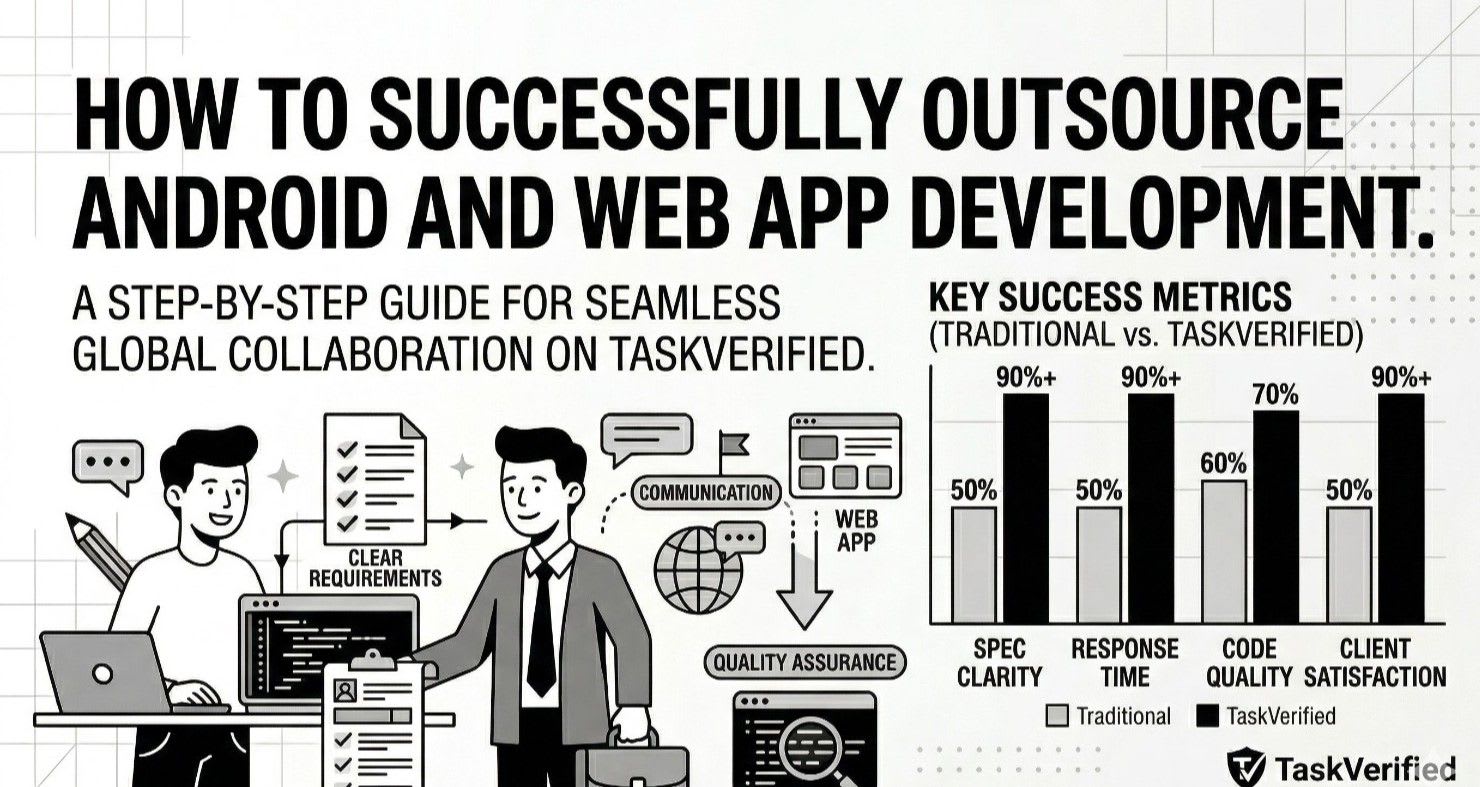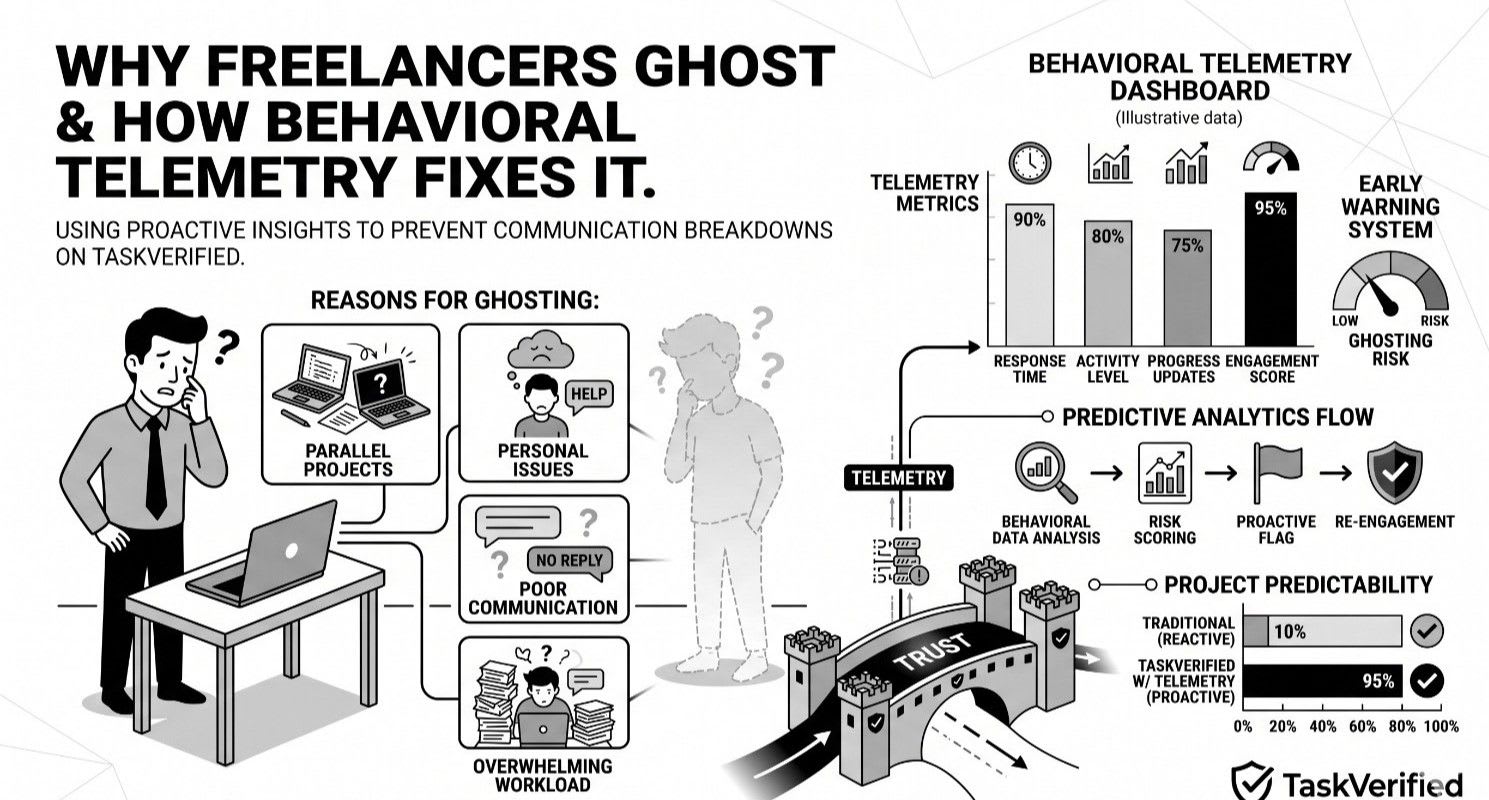
In the distributed workforce economy, ghosting has evolved from a nuisance into a systemic financial drain. Research from the iHire 2024 Study indicates that workplace ghosting has increased by 24 percent since 2021, with 63 percent of project managers identifying non-responsiveness as the primary indicator of catastrophic failure. Beyond the lost deposit, businesses face a Double-Hire Tax, paying up to 2.5 times the original budget to triage and redo abandoned work.
The Management Overhead
Forensic data from the 2025 Leapers Report reveals that up to 30 percent of remote projects encounter significant communication failure. Project managers spend an average of 7.5 hours per week manually chasing contractors, a drain valued at approximately $45,000 annually per manager. Digital escrow alone fails to solve this because it protects the capital but ignores the timeline.
Effective prevention requires moving away from manual trust toward Forensic Governance. This transition involves an 11-point matrix designed to eliminate the common triggers of abandonment. The following analysis explores how structural reasons for disengagement are neutralized through platform logic.
The Forensic Evidence: 2026 Ghosting Statistics
Marketplace Saturation: The freelance sector grew by 90 percent between 2020 and 2024, leading to a "noise-to-signal" crisis where quality contractors are increasingly buried (Source: Mellow Strategy 2024).
Pipeline Overload: Modern freelancers over-commit their actual capacity by 300 to 400 percent to hedge against project instability, causing a 15-30 percent project abandonment rate (Source: Leapers Forensic Report).
Payroll Risk: Approximately 38 to 43 percent of hourly workers admit to some form of time theft, costing businesses up to 7 percent of their total annual payroll (Source: Breeze Time Management Analysis).
Manual Friction: Daily, the U.S. economy loses 50 million productive hours to unrecorded tasks like status updates and chasing unresponsive contractors mid-lifecycle (Source: FinancesOnline 2025).
Under-Billing Vulnerability: 77 percent of freelancers effectively give away free work by under-billing, a financial stressor that eventually leads to "priority jumping" and project abandonment.
Administrative Inbox Drain: Companies lose between $40,000 and $50,000 per employee annually specifically to untracked time spent managing inboxes for contractor status updates.
1. Higher-Paying Work Interruption
Freelancers frequently manage parallel pipelines to maintain income stability. The arrival of a higher-paying contract mid-project is a primary driver of disengagement. Risk increases significantly when the current project rate is below the freelancer's typical range or when scope expands without compensation.
TaskVerified Solution
During task creation, Navya AI suggests standard rates based on real-time market data. This ensures the contract remains competitive. Furthermore, any scope changes require the employer to input and extend both the deadline and the rate, maintaining the professional equilibrium. Payment consistency is reinforced via a Payment Handshake protocol that dispatches automated alerts, removing the possibility of payment being overlooked.
2. Payment Uncertainty and Milestone Ambiguity
Ghosting probability rises sharply when milestones are undefined or approval criteria are unclear. Research indicates that freelancers often disengage pre-emptively when they perceive a structural payout risk. Without a clear "Definition of Done," the perceived effort outweighs the uncertain reward.
TaskVerified Solution
While the platform holds and initiates payments, every interaction is SHA-256 logged to ensure absolute transparency. The task creation process includes detailed fields for milestones and specific Success Criteria to avoid vagueness. The platform alert system ensures the employer is reminded of payment obligations, and the freelancer is required to click "Received" for final settlement.
3. The Low Cost of Abandonment
In traditional remote work environments, legal enforcement is often impossible, making the cost of ghosting effectively zero for the freelancer. Managers report wasting an average of 7.5 hours per week manually chasing unresponsive contractors. This lack of consequence encourages optionality and frequent exits.
TaskVerified Solution
TaskVerified creates high-fidelity audit trails and automatically dispatches alerts when a freelancer's Ghosting Score soars. The platform manages automated follow-ups and deadline reminders, ensuring transparency for both parties. Detailed contact information and requested documentation are available with one click, and internal ratings create a permanent record of engagement.
4. Weak Contractual Obligation and Exit Optionality
Unlike traditional employment, freelance relationships often lack retention mechanisms or termination penalties. This high degree of optionality increases exit frequency. When a freelancer perceives the contract as a "best efforts" agreement rather than a binding professional obligation, the psychological barrier to abandonment remains low.
TaskVerified Solution
Platform logic mandates the use of legally sound contracts drafted with the assistance of Navya AI. These comprehensive agreements must be signed by both parties at the start of every engagement. This requirement transforms the relationship from an informal arrangement into a structured legal commitment, providing a robust retention mechanism.
5. Protracted Client Response Cycles
Repeated feedback delays cause freelancers to mentally downgrade project priority. Latency exceeding 48 hours is a primary warning signal for disengagement. Many employers struggle to give quick feedback because the process of downloading files and matching requirements manually is too hefty.
TaskVerified Solution
The platform includes an automated follow-up strategy, reminding employers of pending submissions via Telegram and email. Employers can preview and annotate files directly in the browser with pin-point, inline comments. Support for live public links like Figma and Canva ensures instant feedback. Furthermore, the Robot PM allows managers to deploy over 120+ objective rules—ranging from foundational word counts to forensic-grade technical audits—blocking non-compliant submissions at the source.
6. Ambiguous Scope Definition and Expectation Mismatch
Unclear deliverables produce repeated revisions and hidden workload growth. When a freelancer feels they are chasing a moving target, the probability of abandonment midstream rises. Statistics show that projects without technical Success Criteria are twice as likely to stall.
TaskVerified Solution
Task creation is templated and detailed, ensuring every relevant field is addressed. Navya AI assists both parties in explaining the project scope clearly during the kickoff phase. By defining quantifiable success metrics from the start, the platform removes the ambiguity that typically leads to terminal disengagement.
7. Reputation Asymmetry and Profile Volatility
Freelancers with shallow portfolios, new profiles, or few reviews statistically abandon contracts more often than established contractors. This asymmetry in reputation means the freelancer has little to lose by disappearing, while the employer bears the full weight of the failure.
TaskVerified Solution
The platform enables the onboarding of an existing roster rather than acting as a cold marketplace. A 7-day grace period ensures that new connections can be evaluated without consuming billing seats if they are disconnected early. Internal ratings and forensic audit trails ensure that every contractor has a professional record tied to their performance.
8. Weak Project Anchoring At Kickoff
Ghosting risk increases significantly when a project lacks a deliverable timeline or a structured communication cadence. Projects that are unanchored tend to drift, as neither party has a clear sense of the next milestone. This structural vacuum creates a psychological exit path for the contractor.
TaskVerified Solution
Every milestone during task creation is structured and anchored with the assistance of Navya AI. Integrated calendars automatically lock in dates, providing native reminders alongside the platform's deadline management. An Engagement Score is visible to both parties, identifying when communication frequency is dropping.
9. Unforeseen Personal or Health Emergencies
Life events, medical emergencies, or sudden family crises are universal factors that can stall any project. In a freelance context, the lack of traditional HR infrastructure often leads to a hunker down mentality where the contractor stops communicating entirely while dealing with the crisis.
General Mitigation Strategy
Foster a culture where over-communication is prioritized. Establish a protocol where an emergency pause message is expected over total silence. Maintaining a Contingency Roster of vetted backup developers ensures that a single point of failure does not derail the entire roadmap. High-authority teams treat redundancy as a project requirement.
10. Technical Complexity Shock and the Dunning-Kruger Effect
A frequent cause of ghosting is the moment a freelancer realizes they are in over their heads technically. Rather than admit a skill gap, many contractors disengage to avoid the perceived shame of failure. This is especially prevalent when initial vetting is shallow and the freelancer overestimates their capacity to solve mid-project technical debt.
General Mitigation Strategy
Utilize progressive tasking: Assign non-critical, simpler tasks during the first 14 days to validate technical depth. Create a safe to fail environment where contractors are encouraged to flag technical blockers early without immediate termination risk. Rigorous technical vetting must be treated as a continuous process.
11. Environmental and Infrastructure Fragility
Localized factors such as power outages, internet censorship, or hardware failure can instantly sever communication. Without documented redundancy, the employer is left in a state of Signal Loss, unable to determine if the silence is due to infrastructure or intent.
General Mitigation Strategy
Verify infrastructure redundancy during the onboarding phase. Ask about backup power solutions and secondary internet providers. Favor geographic diversification within the roster to ensure that a localized utility failure does not stall the entire project roadmap. Diversified redundancy is the only sovereign defense against environmental project risk.
The Predictability Gap: Automate the Intervention
Predicting which freelancer will ghost and which will deliver is an exercise in futility when relying on manual intuition. Human bias often ignores early behavioral signals in favor of professional optimism. The solution is recursive automation. Use the free Ghosting Calculator for an instant diagnostic of your current project risk, or onboard your roster to TaskVerified to automate the telemetry and receive alerts before the silence begins.
The Forensic High-Ground
Ghosting is not a failure of character; it is a failure of environment. By shifting from manual trust to Forensic Output Governance, organizations eliminate the Double-Hire Tax and reclaim the strategic hours lost to administrative friction. High-authority management requires moving from the Black Box to a transparent, data-driven ledger. Let the platform protect the roadmap.