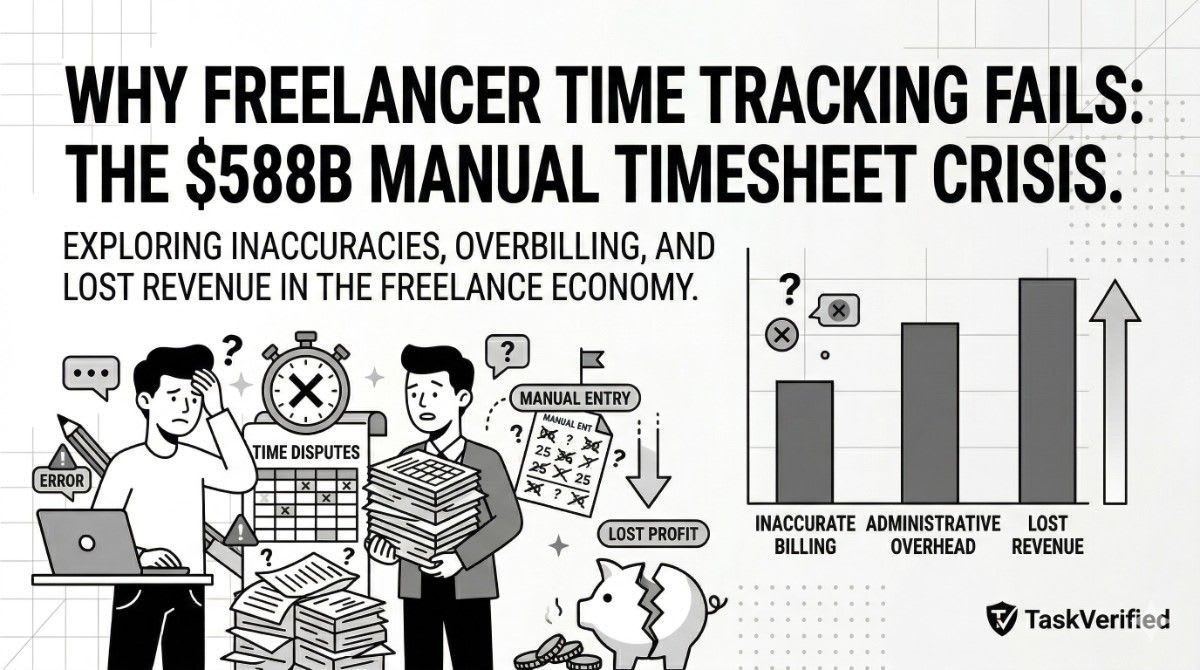
The modern remote economy is producing more output than ever before, but it is also creating a hidden crisis of quality. While 86.5 million people are projected to be freelancing by 2027, the systems used to manage this work are failing to keep pace with the scale of the transition. Project management tools track whether a task is complete, but they do not verify the integrity of the work itself. This gap between completion and verification is where businesses lose time, money, and brand authority.
The Financial Reality
Recent market data indicates that managers spend 6 hours per week on unproductive admin tasks that do not contribute to billable output. This administrative drain is the result of manually checking submissions for basic errors such as incorrect file types or word count failures. Ineffective quality control protocols cost businesses an estimated 588 billion dollars annually.
When a manager receives a deliverable that violates the original instructions, the resulting back and forth creates a delay in the production cycle. This is known as Review Debt. By implementing a task verification standard, businesses can eliminate this debt by ensuring that non-compliant work is blocked at the submission gate. Task verification moves project requirements from the sidebar chat into the core logic of the platform.
This article explores the architectural protocols required to move beyond project tracking and into the realm of forensic validation. The following sections detail how the Task Verification Standard enforces quality and eliminates Review Debt.
What is Task Verification?
Task verification is the operational layer that sits between the submission of work and its final acceptance. While project management focuses on the logistics of who is doing what and when, task verification focuses on the forensic integrity of the deliverable. It is the transition from a trust based management model to a verification based architecture.
Consider a standard content project. In a traditional project management system, a manager sees that a freelancer has changed a task status to completed. The manager must then manually open the document to check for word counts, tone alignment, and plagiarism. With task verification, these requirements are codified. The system performs an automated audit at the point of entry, only allowing the status to change if the work meets the predefined technical standards.
For a design project, this might mean the platform automatically checks that a logo is submitted in the correct vector format and includes the specified brand colors before the manager is even notified. By enforcing these rules at the submission gate, task verification eliminates the administrative friction of manual quality control and ensures that every piece of work enters the production pipeline in a verified state.
Why Task Verification is the Need of the Hour
The traditional definition of done is a submission button. For the modern employer, this metric has become a liability. As the volume of digital output scales, the quality of that output is being hollowed out by a phenomenon known as the Rework Tax. Research from Workday and Hanover indicates that approximately 40% of productivity gains from AI are subsequently lost to rework. Managers are finding that the time saved in drafting is being spent on fact checking, tone correction, and fixing structural failures.
The Critical Risk Profile
52%
Of businesses cite factual inaccuracy and AI hallucinations as their greatest operational risk when outsourcing.
1.5 Weeks
The amount of time heavy AI users spend per year strictly on fixing and verifying subpar outputs.
In this environment, a submission is merely a suggestion of completion. True task verification requires that the definition of done is replaced by a rigorous adherence to style guides and technical guardrails. This necessitates a multi layered audit that ranges from basic metadata checks to complex forensic scans:
Structural Metadata
Verification of file counts, size limits, and URL slug integrity to ensure immediate compatibility with production systems.
Security Forensics
Automated PII detection and stripping to protect sensitive data and ensure compliance with global privacy standards.
Linguistic Integrity
Entity preservation and tone audits to prevent brand dilution and ensure content remains human centric.
Technical Validation
Deep code audits and AI contamination scans to filter out slop and maintain the highest technical standards.
When 73% of consumers report reduced engagement with content they suspect is AI generated slop, the cost of a failed verification gate is not just lost time: it is lost brand authority.
Task Verification for Content Teams: Ending the AI Slop Crisis
How do I scale my content team without spending 5 hours a day on manual editing? This is the question every marketing manager is asking as they struggle to manage high-volume output. Content task verification solves this by moving quality control from the editor's desk to the platform gate. Instead of manually checking every paragraph for wall-of-text issues or passive voice, the Robot PM enforces your style guide before the draft even touches your inbox.
The Manual Review Loop
The manager downloads a draft and realizes it is 50% passive voice with no introductory hook. They have to send it back, wait for a revision, and re-review it later. This is the "Rework Tax" in action.
Verified Content Flow
The platform blocks any submission that violates the style guide. The freelancer gets instant feedback on word counts, tone, and readability. You only receive work that is "human-centric" and ready for publication.
By automating linguistic and structural audits, businesses can scale their publishing frequency without diluting their brand voice. Here are the core rules used to verify content deliverables:
Linguistic Integrity
Automated spelling and grammar audits ensure a professional baseline across all deliverables.
AI & Plagiarism Sieve
Hard-gate content authenticity by detecting AI-generated patterns and potential IP duplication before review.
Writing & Content Verification Rules
-
Word Count Enforcement: Ensure deliverables meet the precise length requirements defined in the task brief.
-
Spelling & Linguistic Integrity: Automated multi-language spell checking to ensure professional-grade written deliverables.
-
Readability Performance Guard: Evaluate content complexity to ensure alignment with the target audience reading level.
-
Passive Voice Ratio Audit: Forensic analysis of active vs. passive sentence constructions to ensure direct communication.
-
Sentence Length Guard: Maintain readability by enforcing limits on average sentence length and capping runaway sentences.
-
Paragraph Density Guard: Optimize user engagement by preventing "walls of text" through strict paragraph limits.
-
Filler Word Density Audit: Maximize the value of every word by identifying and limiting fluff, jargon, and redundant phrases.
-
Repetition Guard Forensics: Detect and eliminate repetitive phrasing, lazy word choices, and content-spinning artifacts.
-
Heading Count Enforcement: Enforce structural hierarchy and scannability by auditing the volume and sequence of headings.
-
Introductory Hook Audit: Maximize retention by ensuring the first paragraph is concise, impactful, and below word-count limits.
-
Required Section Completeness: Verify the presence of mandatory named sections like Introduction, Conclusion, and CTA.
-
AI Detection Sieve: Hard-gate content authenticity by auditing submissions for AI-generated patterns and non-human markers.
-
Real-Time Fact Check Guard: Hard-gate factual integrity by verifying assertions against the Google Fact Check Tools API.
SEO Integrity: Proving Authority to Search Engines
Is my content actually going to rank on Google? Most SEO strategies fail because the execution doesn't match the strategic brief. A writer might miss the target keyword in the H1 or forget to add alt text to critical images. SEO task verification ensures that every piece of content is technically perfect for search engines. It turns your SEO plan into a hard-coded set of requirements that the system validates automatically at the submission gate.
Keyword Optimization
Hard-gate target keyword presence and density in critical semantic zones like Title, H1, and Introduction.
Link Health Audit
Verify that every external URL is reachable and that the balance of internal and external citations is strategically sound.
SEO & Visibility Verification Rules
-
SEO Keyword Optimization: Ensure keywords are placed in critical semantic zones for maximum search engine signaling.
-
SEO Meta Length Audit: Prevent SERP truncation by ensuring Title and Meta Description lengths are within optimal bounds.
-
SEO Link Ratio & Distribution: Enforce interlinking strategies by managing the balance of internal and external citations.
-
SEO Image Alt Text Forensics: Hard-gate accessibility and SEO by ensuring every visual asset has descriptive, unique alt text.
-
SEO Anchor Quality Guard: Maximize link equity by ensuring anchor text is descriptive and free of generic patterns.
-
Live Hyperlink Audit: Hard-gate document usability by verifying that every external URL is reachable and functional.
Technical & Data Teams: Hard-Gating Technical Debt
How can I manage remote developers without receiving broken code? Technical teams face a unique challenge: a single comma out of place in a JSON file or a syntax error in a script can halt an entire production pipeline. Task verification for technical and data teams applies a forensic lens to every submission. It verifies schemas, checks complexity, and ensures that documentation is actually usable before a developer ever marks it as done.
Schema & Structural Integrity
Automated verification of JSON/CSV structures and API schemas ensures that new data and code integrate seamlessly with existing infrastructure.
Documentation & Code Audits
Deep inspection of code blocks, technical metadata, and error resolution steps to prevent technical debt and ensure long-term maintainability.
Technical & Data Verification Rules
-
Syntax Validation & Parsing: Ensure code and data files are syntactically correct and ready for production deployment.
-
Technical Complexity Guard: Analyze code complexity to prevent technical debt and maintain long-term scalability.
-
Schema Structural Validation: Ensure JSON and CSV files follow a strict structural schema for automated data ingestion.
-
API Endpoint Governance: Hard-gate RESTful standards by auditing endpoints for path casing and method synchronization.
-
Error Resolution Assurance: Verify that all mentioned error codes are documented with actionable resolutions.
-
Technical Code Audit: Audit code blocks for syntax accuracy, security hazards, and UX compatibility.
-
Technical Metadata Forensics: Enforce documentation standards, including versioning, ownership, and SEO metadata audits.
-
File Type Compliance: Restrict uploads to authorized file extensions and verified MIME types via magic-number sniffing.
Brand, Compliance, & Legal Safety
How do I protect my brand from legal lawsuits and PII leaks? In the remote economy, data privacy and brand consistency are high-stakes issues. A freelancer accidentally including a customer email or using a competitor's name can cause irreparable damage. Task verification for compliance teams creates a legal safety net. It automatically scans for sensitive information and enforces brand terminology, ensuring every deliverable is safe, professional, and on-brand.
The Compliance Firewall
Protect your business with automated PII detection, mandatory legal disclaimer verification, and brand terminology enforcement. TaskVerified ensures that your intellectual property remains secure and your professional standing is never compromised by accidental oversights.
Brand & Compliance Verification Rules
-
PII Detection Guard: Hard-gate data privacy by detecting and blocking sensitive info like Credit Cards and SSNs.
-
Brand Terminology Consistency: Enforce preferred terminology across body text, slugs, and image metadata.
-
Competitor Mention Firewall: Protect market positioning by blocking unauthorized mentions of competitor brands.
-
Mandatory Disclaimer Audit: Verify the presence and substance of required legal disclaimers and disclosures.
-
Profanity & Slur Filter: Protect brand safety by detecting and blocking offensive language and unprofessional noise.
-
Superlative Claim Guard: Mitigate legal liability by flagging unsubstantiated claims and exaggerated marketing language.
-
Affiliate Disclosure Audit: Hard-gate FTC compliance by detecting affiliate links and verifying mandatory disclosures.
-
Capitalization Style Audit: Enforce professional standards by auditing headings for Title Case or Sentence Case consistency.
Localization and Global Strategy
How do I prevent my international campaigns from falling apart due to semantic drift? Translation is more than just swapping words; it is about preserving intent and voice across cultures. Localization task verification ensures that your global content maintains its integrity. It detects when a translation has lost its professional tone or when critical entities like brand names or numbers have been mishandled, protecting your reputation in every market.
Global Localization Verification Rules
-
Language Integrity Audit: Ensure deliverables are written in the correct target language and dialect.
-
Voice Governance Guard: Enforce brand-specific tone and persona requirements in translated content.
-
Semantic Drift Audit: Detect and flag translations that have deviated from the original technical intent.
-
Entity Preservation Guard: Ensure that brand names and critical nouns are preserved across languages.
-
Number Integrity Check: Verify that dates, currencies, and measurements are correctly formatted for the locale.
AI Training and Annotation Governance
How can I trust the human-in-the-loop data powering my AI models? AI training is only as good as the underlying labels. Annotation task verification creates a hard-gate for data quality. It identifies lazy labeling through entropy analysis and ensures that evaluators provide rationalized, consistent feedback. By enforcing strict rubrics at the point of entry, you eliminate the garbage-in, garbage-out cycle that plagues machine learning projects.
AI Training Data Verification Rules
-
Rubric Taxonomy Compliance: Hard-gate AI training data quality by enforcing project-specific terminology.
-
Rationalized Response Audit: Ensure quality by auditing rationales for Shannon Entropy and vocabulary breadth.
-
Annotator Determinism Guard: Ensure data reliability by identifying inconsistencies in annotator behavior.
-
Categorical Diversity Guard: Detect lazy labeling patterns through Shannon Entropy and streak detection.
-
Pairwise Consistency Guard: Hard-gate preference data by detecting circular logic and positional bias.
-
Score Range Forensic Guard: Enforce strict rubric boundaries and identify sentiment mismatches (ISO/IEC 5259 Compliant).
-
Annotation Rubric Length Gate: Enforce minimum and maximum length requirements for annotation feedback.
Media, Marketing, & Geospatial Forensics
How do I verify that a field researcher actually took a photo at the right location? Media deliverables and field tasks require a specific type of forensics. Media and geospatial task verification audits the metadata behind every file. It verifies video durations for ad compliance, audits PDF structures, and uses GPS coordinates to prove that real-world tasks were completed exactly where they were supposed to be.
Media, Marketing, & Asset Verification Rules
-
Video Duration Compliance: Hard-gate media deliverables by enforcing precise playback duration constraints.
-
Audio Length Integrity: Enforce strict duration constraints for AI training sets and voiceover assets.
-
PDF Document Structure: Enforce page count constraints and audit for document structural integrity.
-
Image Resolution & Dimensions: Hard-gate visual quality by enforcing mandatory width and aspect ratio.
-
Social Handle Auditor: Verify the formatting and availability of social handles in marketing copy and bios.
-
Hashtag Density Auditor: Enforce strategic hashtag limits to maximize reach and prevent suppression.
-
Marketing Buzzword Auditor: Identify and flag overused cliches and vague superlatives that dilute brand authority.
-
Geographic Area Guard: Validate task authenticity by verifying GPS coordinates in image EXIF metadata.
Moving Toward the Verified Economy
The transition from project management to task verification is a shift from monitoring to enforcement. By adopting these category-based standards, businesses can eliminate Review Debt, protect their IP, and scale their remote operations with forensic-grade confidence.