
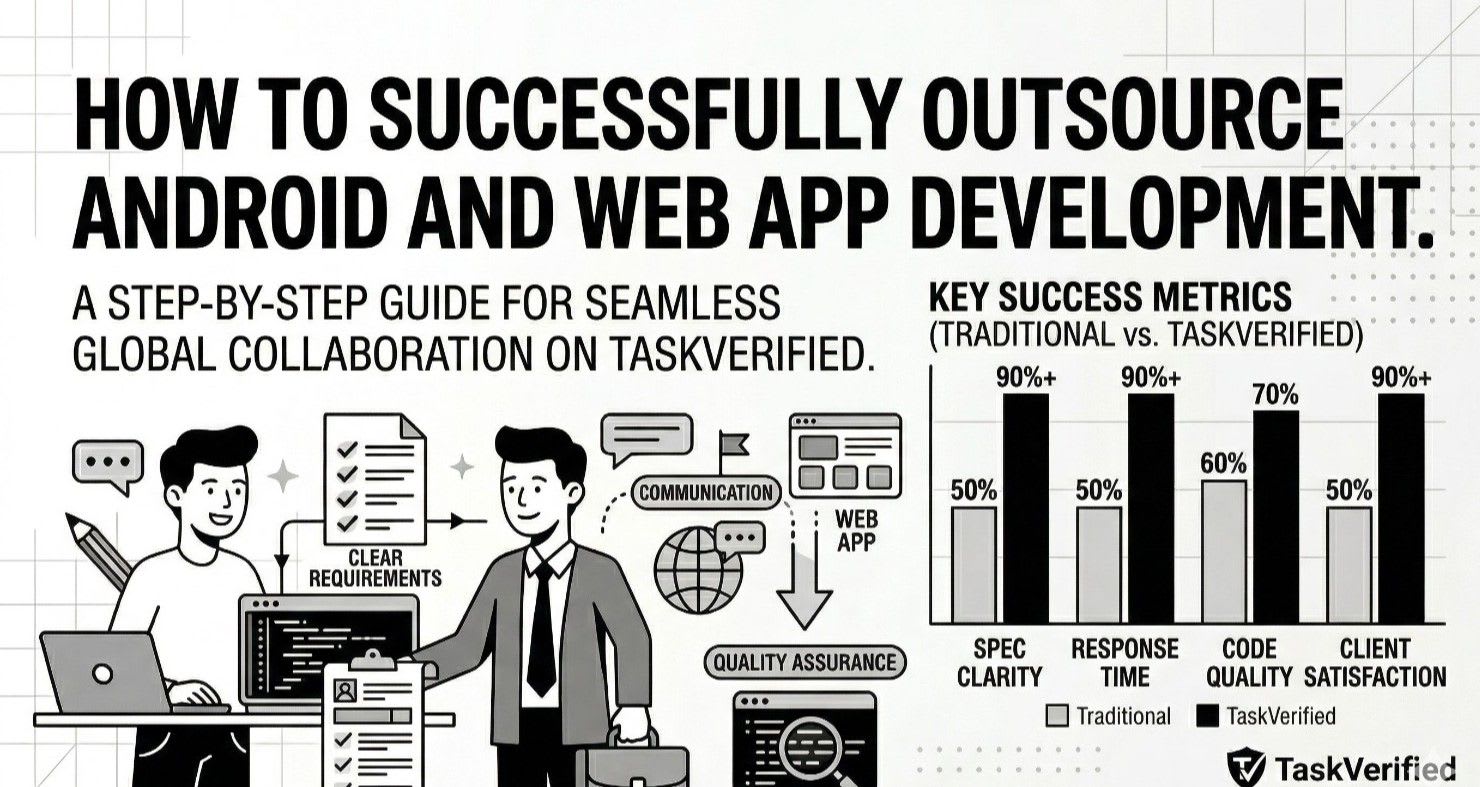
The global mobile app outsourcing market is projected to reach over USD 1.6 billion by 2033. While the potential for cost reduction is high, between 15% to 70% in some cases, the reality is that many projects stall not due to a lack of talent, but due to a lack of forensic management.
The strategic pivot required to answer how do I ensure successful development of Android app and web app by outsourcing to freelancers begins with moving away from the "Trust-First" model toward a "Verification-First" architecture. Success in outsourcing Android and Web applications is not a matter of luck. It is the result of a strictly enforced technical environment that eliminates ambiguity from day zero. This guide details the 11 forensic points required to transform unverified ideas into a production-ready reality.
Defining Scope and Goals with Forensic Precision
Ambiguity is the most expensive variable in software development. Most project failures can be traced back to a "Requirement Gap," where the employer assumes a feature is intuitive while the developer interprets it through the lens of least resistance. To ensure success, one must document the platform requirements, the target audience, and the non-functional needs like security and performance before the first line of code is written.
Measurable success criteria are the only way to objectively judge a freelancer's output. If a goal cannot be quantified, it cannot be managed. This means defining exactly what "done" looks like for every module. Without this clarity, one enters a cycle of subjective revisions that drain the budget and frustrate high-tier talent.
The TaskVerified Solution
TaskVerified solves the "Scope Gap" through its AI-driven project assistant, Navya. Instead of starting with a blank page, Navya analyzes task categories in real-time to suggest optimized budgets and draft comprehensive instruction blocks.
By utilizing over 20 specialized categories — from Full-Stack Development to UI UX Design — the platform ensures that every task contains the industry-standard mandatory fields and metadata schemas required to eliminate ambiguity.
Hiring for Competence, Not Just Portfolio
A portfolio of screenshots is a marketing asset, not a technical proof. When outsourcing for specific stacks like Kotlin for Android or React for the web, one must verify the candidate's actual contributions to those projects. This involves a thorough review of public GitHub repositories and a cross-reference of client reviews that speak to the freelancer's reliability under pressure.
The shortage of local IT talent drives nearly 76% of firms to look globally. However, this global search requires a stricter vetting process. One must move beyond the "interview vibe" and demand concrete evidence of technical stack mastery. Experience has shown that a freelancer's ability to document their work is often as important as their ability to write the code itself.
Verified Skill Mastery
TaskVerified addresses the vetting gap through its Skill Mastery Engine. Instead of relying on self-reported claims, the platform mathematically calculates mastery levels based on the volume of verified tasks and AI Authenticity scores achieved in specific technical categories.
This provides a forensic look at a freelancer's actual track record within your workspace, allowing you to assign high-stakes Android or Web modules with 100% confidence in the developer's proven execution capability.
Executing a Structured Legal and Technical Handshake
The first 48 hours of an engagement dictate the project's ultimate outcome. A formal kick-off meeting is not just a polite introduction; it is a synchronization event where wireframes, user stories, and architecture outlines are shared. The goal is to provide the freelancer with the full context of the application, rather than treating them as a siloed task-taker.
Onboarding must also include a "Legal Handshake." This involves establishing the financial and compliance parameters upfront. When these boundaries are set early, it prevents the "Administrative Opacity" that leads to disputes later in the lifecycle. Professionalism is established by the systems you put in place, not just by the person you hire.
Unified Compliance Architecture
TaskVerified routes every new hire through a multi-step compliance wizard that finalizes legal agreements, security enforcements like 2FA, and settlement parameters before work begins.
By automating this operational hygiene, the system ensures that the "Legal Handshake" is immutable and tax-compliant, allowing the founder to focus exclusively on the technical kick-off.
Sequential Milestones and the Financial Intent Handshake
Software projects die in the "Infinite Middle." Without clear milestones, a project becomes a continuous drain on resources with zero visibility into the actual finish line. Breaking the project into distinct phases — design, core Android module, API integration, and final UI — ensures that capital is only released upon the verification of tangible deliverables.
Outsourcing in hybrid setups can make teams deliver MVPs up to 7 weeks sooner, but only if the delivery triggers are strictly enforced. Each milestone must be a "Hard Stop" where quality is verified before the next phase begins. This technical guardrail prevents the accumulation of technical debt and keeps the project timeline honest.
Progressive Funding and the 5-Stage Handshake
TaskVerified replaces vague payment promises with a Sequential Milestone architecture. To protect the employer, milestones are first marked as "Funded" on the ledger to record professional intent, but the capital is only "Released" once the deliverable is accepted.
This is supported by a 5-Stage Payment Handshake — including Proof Provisioning and a Dispute Grace Period — ensuring that the settlement process is backed by a tamper-evident audit trail of bank receipts and reference numbers, regardless of the external payment rail.
Establishing a Task-Centric Communication Architecture
Communication gaps are cited as a primary pitfall in outsourced software development. Fragmented communication across Slack, email, and various DMs creates an "Information Void" where critical technical decisions are lost. A successful project requires a single, context-aware channel where every message is anchored to a specific deliverable.
Syncing time zones and cultural nuances is a management challenge that cannot be solved by more meetings. It is solved by better "Asynchronous Fidelity." Every decision, requirement shift, and technical blocker must be documented in a way that is audit-ready. This ensures that even when the developer is offline, the "Technical Truth" of the project remains visible and unalterable.
The No-DM Topology
TaskVerified eliminates the noise of fragmented chat through its strict Task-Centric Communication Model. By removing global Direct Messages and anchoring every interaction to a specific Task ID, the platform ensures that 100% of collaboration is contextualized.
This topology provides a tamper-evident narrative of the project, allowing owners to reconstruct the entire history of technical decisions during a compliance audit or a quality review.
Integrating External Talent into the Product Culture
Treating a freelancer as a "Disposable Unit" leads to a "Disposable Product." Successful founders involve their external developers in the deeper requirement discussions and UX feedback loops. This increases the freelancer's sense of ownership and often surfaces technical solutions that an employer might have overlooked. When a developer understands the "Why" behind a feature, they are far more likely to deliver code that is resilient and scalable.
Ownership is not a feeling; it is a metric. It is measured by the developer's proactive engagement with the project's goals. While cost reduction is a major driver of outsourcing — with over 85% of companies meeting their quality expectations — the true value is found in the long-term collaboration that develops when a freelancer is treated as a core part of the engineering team.
Roster Engagement Pulse
TaskVerified provides deep visibility into team health through the Roster Pulse system. This engine analyzes 30-day activity logs and task velocity to assign engagement labels, helping employers identify their most proactive collaborators.
Combined with the Trust Index Reputation Score, founders can objectively measure the reliability of their team, ensuring that high-performing talent is recognized and retained for the long-term roadmap.
Enforcing Forensic Version Control and Documentation
Quality is not a variable that should be checked at the end of the project. It must be enforced at the line-of-code level. Requirement of Git version control with structured pull requests, clear commit messages, and high-fidelity documentation is non-negotiable. Without these, the codebase becomes a "Black Box" discovered only when the developer transitions out of the project.
Poorly architected outsourced code represents a massive security risk. Technical and security gaps found post-integration can cost more to fix than the original development. Founders must insist on code-review standards and automated style guides to ensure the project remains maintainable for years to come.
The Robot PM (Automated Quality Intelligence)
TaskVerified automates the objective review cycle through the Robot PM — a registry of 26+ intelligent validation checks. These gates physically block non-compliant submissions, verifying technical syntax (JS, TS, HTML, CSS) and logic complexity before the work even reaches the employer’s desk.
This is combined with Deep Annotations, allowing employers to pin precise, labeled feedback (Bug, Change Request, Suggestion) directly to specific lines of code inside the native preview modal.
Implementing Private KPI Tracking and Performance Audits
Management without metrics is just opinion. To objectively judge a freelancer’s performance, one must define and track Key Performance Indicators (KPIs) such as bug-fix turnaround times, test coverage ratios, and post-launch crash rates. These metrics provide the data required to separate "Activity Theatre" from actual technical velocity.
According to industry data, 55% of organizations fail to track the benefits of their outsourcing partnerships. Moving from subjective "Check-ins" to objective "Audits" ensures that the developer is held to a professional standard. This requires assigning specific, private benchmarks at the moment of task creation and updating them as the project complexity evolves.
ROI Benchmarking and Shadow CRM
TaskVerified permits employers to inject private ROI Metric benchmarks directly during the 7-step task creation wizard. These KPIs are assigned privately to measure the ultimate performance impact of the work upon completion.
Ongoing management is handled through the Cloaked Metadata layer, where employers can update private internal performance notes and multi-tags. These are 100% hidden from the freelancer but contribute to a comprehensive Efficiency Profile that tracks turnaround speed and accuracy over the rolling 6-month window.
Securing the Crown Jewels: Contracts and IP Ownership
The source code is the most valuable asset of an Android or Web project. Trusting that a freelancer "knows" you own the IP is not a strategy. One must agree on contracts, NDAs, and clear intellectual property ownership terms before the first module is assigned. These documents must specify the scope, payment triggers, and the explicit transfer of assets upon final settlement.
Risks of IP leakage or "Code Hostaging" are real when working with unverified freelancers. Accountability and control over deliverables must be established through a legally-bound handshake. One should never assume that the final payment automatically grants ownership without a signed, traceable agreement that can withstand legal scrutiny.
The IP Transfer Hook
TaskVerified encodes the Legal Layer into its technical architecture. Every invitation enforces a mandatory IP Transfer Agreement, ensuring that all work produced belongs to the employer upon final settlement.
This is reinforced by the Task-Specific Contract layer, which allows owners to inject unique NDAs that the freelancer must acknowledge before viewing sensitive project resources, providing a technical guarantee of operational security.
Implementing Continuous QA and Testing Protocols
A successful launch is never an accident; it is the result of a continuous verification cycle. One must move beyond the "Buggy Launch" syndrome by enforcing specific testing protocols—including unit testing for Android modules and cross-browser verification for web apps. Every submission should be treated as a "Release Candidate" that must pass a set of objective quality gates before even reaching the human review stage.
Automating the objective review cycle reduces the feedback loop and prevents clear errors from entering the main branch. The goal is to establish a "Verification Gate" that checks for both technical syntax and functional requirements instantly. This discipline ensures that the high-level review can focus on the product's UX rather than chasing simple implementation bugs.
The Robot PM (Validation Registry)
TaskVerified automates this rigorous quality filter through the Robot PM — a registry of 26+ intelligent validation rules. These rules check for everything from technical syntax errors (JS, TS, HTML) to data schema integrity before a submission is accepted.
Combined with Preview-Driven Verification, employers can virtually interact with deliverables — from Figma designs to live code files — right inside the platform. Pinned annotations then bridge the communication gap, allowing for pixel-perfect feedback that the freelancer can resolve in the next rework cycle.
Planning for Day 2: Continuity and Long-Term Support
The project does not end at the final payment; that is simply the beginning of its operational life. Long-term success requires a strategy for post-launch maintenance, bug support, and feature expansion. This continuity is only possible if one has full custody of the project’s historical context—including every technical decision, rework cycle, and communication thread.
Establishing an immutable audit trail is the only way to protect the "Technical Truth" of your application. When team members change or new freelancers are onboarded for maintenance, they must be able to reconstruct the application's history through a verifiable record. Forensic management ensures that your application remains an asset you control, rather than a liability left behind by a disconnected freelancer.
The SHA-256 Audit Pulse
TaskVerified ensures long-term continuity through its tamper-evident SHA-256 Audit Trail. Every single status change, rework request, and payment release is permanently recorded and vaulted, creating an immutable history of the project.
When the project moves into the maintenance phase, the Task Lifecycle Archive provides a complete historical context, ensuring zero loss of momentum during handovers and providing a definitive source of truth for future feature expansions.
From Unverified Ideas to Forensic-Grade Success
Success in outsourcing is a choice made at the system level. By enforcing these 11 forensic points, founds can transform the inherent unpredictability of freelance management into a structured engine for growth. The goal is simple: eliminate ambiguity, verify competence, and maintain absolute custody of your project's integrity.

