Most freelance management platforms function as little more than glorified escrow services with a side of unmoderated chat. When a relationship sours, they rely on subjective human mediation to decide who is right. This approach is fundamentally flawed because it treats disputes as a personality conflict rather than a failure of the project environment. Evidence from decades of operational oversight proves that the vast majority of professional friction stems from architectural gaps where clarity should have been enforced by code.
The Administrative Reality
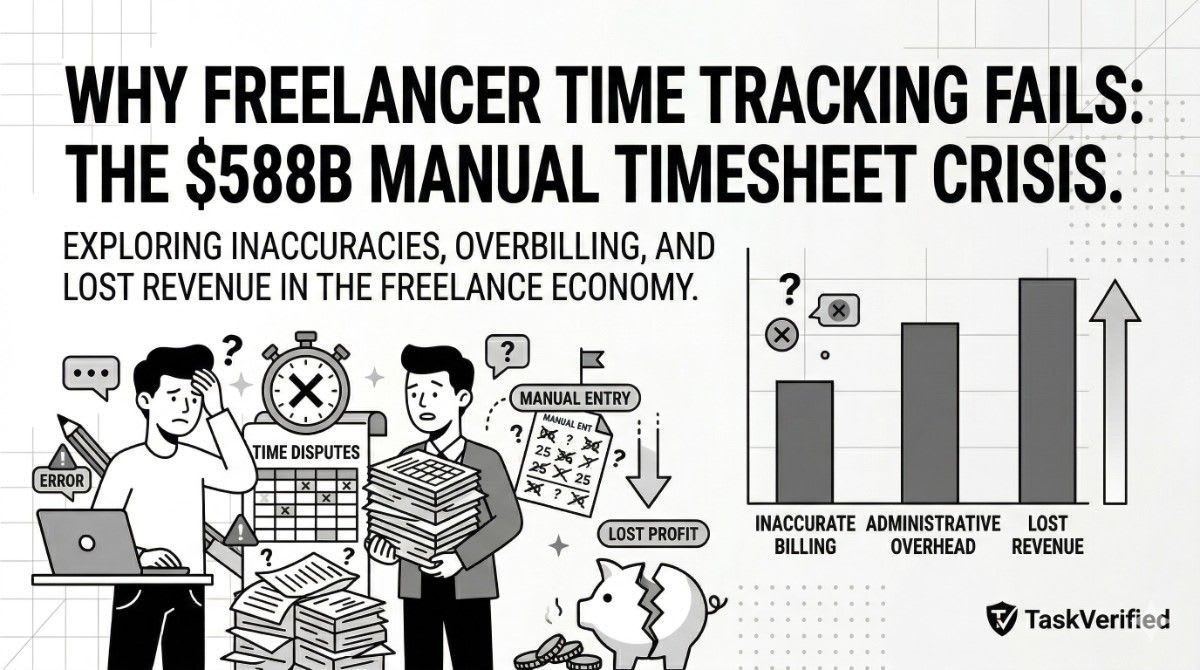
Recent studies indicate that 74% of projects face significant payment friction, often due to poor administrative oversight and vague requirement tracking. This systemic failure triggers a cycle of disputes that drains over 10% of weekly agency productivity. Relying on manual timesheets and fragmented DMs creates an environment where evidence is scattered and easily manipulated, leaving employers vulnerable to "administrative traps."
True accountability requires a move toward forensic workforce management. For agency owners, this means replacing the legacy model of "trust-but-verify" with a system of absolute, unbypassable truth. This means moving project requirements and quality standards from the sidebar chat into the core logic of the platform. A professional environment demands that the "Definition of Done" is not a suggestion, but a technical gate that protects your budget and your delivery timeline. Architectural enforcement is the only sustainable way to build a high-trust global team.
This article systematically breaks down the architectural protocols required to eliminate professional friction. The following sections explore how a forensic ecosystem implements Truth Gates to achieve a documented 75% reduction in project disputes.
The Quality Gate: Why Objective Standards Precede Professional Trust
Professional friction often begins with the "Subjectivity Trap." In a standard freelance environment, a "Definition of Done" is a loose set of bullet points in a chat window. This lack of rigidity leads to the inevitable rework loop. Statistics show that 45% of platform disputes arise from "Work not as described," costing employers thousands in lost time and duplicated effort.
Without The Gate
The employer spends three hours reviewing a submission that is fundamentally broken. They must manually check word counts, verify file formats, and run plagiarism scans. The feedback process is angry, subjective, and slows down the entire engineering or marketing pipeline. This is where most relationships die.
With The Gate
The employer sets the rules once and focuses on strategy. If the work does not meet every technical requirement, it is physically impossible for the freelancer to submit it. The "bad work" never reaches the employer's desk. Trust is preserved because the system, not the person, enforces the standard.
TaskVerified solves this via the Validation Registry, or the Robot PM. This system ensures that all work is objectively verified against a set of 120+ forensic-grade quality gates before it ever reaches the human review stage. Explore the full list in our [Rules Library](/rules). Common rules include:
Technical Guardrails
Ranging from foundational checks (file types, word counts) to forensic-grade audits (technical syntax, AI markers), the system ensures the brief was actually followed.
Format Enforcement
Verification of file extensions and specific naming conventions protects the automated internal pipelines of the employer.
Integrity Gates
Integrated 120+ checks for AI contamination, plagiarism, and legal compliance preserve the technical integrity of the deliverables.
The Hard Stop
The platform physically blocks submissions that fail any rule, preventing "bad data" from ever entering the system.
By removing the human element from initial validation, the system handles the quality friction. This allows both parties to remain on the same side of the table. The Robot PM becomes the silent guardian of the professional relationship.
Visual Precision: Eliminating the Interpretation Gap
Friction in remote delivery often arises from the localized "Feedback Tax." When an employer must download a file, open a third-party application, and take a screenshot just to explain a single adjustment, the context is diluted. This fragmented process leads to the interpretation gap. A simple request like "fix the spacing here" can trigger an hour of unproductive back-and-forth because the visual anchor is missing.
Without Precision
The employer spends fifteen minutes recording a screen-share or annotating a static image in an external tool. The freelancer receives the feedback in a separate chat thread, disconnected from the original task history. Context dies in transit.
With Precision
The employer pins a specific pixel-coordinate or video timestamp directly on the platform. The freelancer opens the task and sees exactly where the adjustment is needed. Zero Interpretation. Zero Friction.
TaskVerified eliminates this friction through a Native Browser Preview Engine. This system allows for deep, entity-specific annotations directly on the platform. By centralizing feedback on the deliverable itself, the relationship remains focused on progress rather than clarification.
🎯 Support Protocols
- Video: Frame-accurate timestamps for precise motion and edit feedback.
- Code: Line-level syntax highlighting and git-style diff commenting.
- Documents: Regional text selection and paragraph-specific sticky notes.
- Images: Pixel-coordinates for UI/UX adjustments and visual bugs.
This protocol ensures that every piece of feedback is anchored to a specific coordinate or timestamp. There is no confusion about which component needs fixing because the system provides a persistent, shared visual context for both parties. Feedback becomes an objective data point rather than a subjective interpretation.
The Forensic Result
Reducing the steps required to provide feedback from minutes to seconds prevents the feedback fatigue that typically leads to relationship burnout. High-trust teams rely on the speed of precision.
Sovereign Visibility: Ending the Black Box Trap
The traditional remote workflow suffers from the "Project Black Box" problem. Handing off a task and waiting days for a delivery creates a high-risk environment. This lack of transparency leads to "Sunk Cost Friction," where entire milestones are rejected because a wrong turn was taken in the first hour of work. The cost of discovery is often too high because it happens only at the point of final submission.
The Black Box
A freelancer spends forty billable hours building a feature based on an outdated version of the API documentation. The employer discovers the error during the final review. The entire budget is exhausted and the project timeline is shattered.
The Synced Suite
The employer monitors progress through a synced live workspace. Ninety minutes into the task, they notice the misalignment and provide a minute of guidance. The project remains on course and the relationship is strengthened through collaboration.
TaskVerified addresses this through Mirrored Live Workspaces. For projects involving public components or collaborative tools such as Figma, GitHub, or Notion, the system maintains a persistent live preview for the employer. This allows for real-time oversight without the intrusiveness of a manual check-in call.
Sovereign Visibility Advantages
-
Eliminates the "Status Update" culture by providing immediate transparency.
-
Enables early detection of scope creep or technical misunderstandings.
-
Enhanced accountability through consistent visibility into the active workflow.
-
Reduction in "Last Minute Stress" during the final milestone settlement.
Transparency is not a tool of micromanagement; it is a tool of alignment. By providing sovereign visibility into the work as it happens, both parties move with the confidence that the direction is correct.
Temporal Fidelity: Solving the Timesheet Conflict
Hourly billing remains a primary friction point in global remote work. Traditional methods rely on either "The Honor System," which lacks accountability, or "Voyeuristic Surveillance" through invasive screenshots. Both approaches fracture the professional relationship. Data from the State of Freelance Work 2025 reveals that 21% of employers report inaccurate billable hours as a top operational risk.
The Subjective Hour
A freelancer logs eight hours for a task that includes unbilled breaks and personal distractions. The employer receives a static invoice at the end of the week with no evidence of the actual work distribution. Suspicion grows.
The Linear Hour
The freelancer tracks time through a protocol that enforces linear fidelity. The system automatically pauses during idle periods and locks the billable hour against a predefined budget. Both parties see exactly what was worked.
TaskVerified addresses this through the TrustClock, a temporal fidelity instrument. Instead of a simple stopwatch, the system uses a synchronized state that survives browser crashes and network interruptions. It transforms time tracking from a record of presence into a verifiable ledger of productivity.
The system halts the timer automatically if the freelancer fails to log mandatory evidence or exceeds a budget cap, protecting project financials.
Configurable rules allow for small idle windows, ensuring that brief interruptions do not result in contested billing blocks.
The freelancer progress is mirrored to the employer dashboard in real-time. There are no surprises at the end of the week.
Trust is built on the synchronization of data. By removing the subjectivity of the billable hour, the platform ensures that payment is always a reflection of verified effort.
Contextual Chat: Ending Fragmented Communication
Professional communication often dies in the "DM Void." When project approvals, requirement changes, and technical feedback are scattered across various Slack threads or email chains, the single source of truth is lost. This fragmentation leads to the "He-Said-She-Said" trap, where disputes arise simply because one party cannot find the documentation for a specific agreement.
The DM Void
The employer approves a significant scope change in a late-night DM. Three weeks later, during the final review, the employer forgets the change and disputes the deliverable. Both parties spend hours searching through chat logs to prove their position.
The Task Anchor
The scope change is discussed and approved directly within the relevant Task-ID thread. The approval is permanently tied to the task history. When the final review occurs, the context is immediately visible to both parties. No search required.
TaskVerified enforces a No-DM Architecture. By anchoring all communication to specific Task-IDs, the platform ensures that project context remains unified. This protocol eliminates the administrative overhead of "Context Switching" and provides a clean, audit-ready history for every deliverable.
Communication Guardrails
Message-Task Binding
Every message is physically linked to a task, preventing the loss of critical project data in unorganized threads.
Immutable History
Chat history is preserved as part of the project audit trail, ensuring that approvals are always verifiable.
Clarity is a function of proximity. By keeping the conversation next to the work, the system eliminates the ambiguity that fuels professional conflict.
Forensic Integrity: The Immutable Audit Trail
Professional records are often victims of the "Erasure Trap." In most collaboration tools, history can be edited, comments can be deleted, and logs can be sanitized. When a dispute occurs, especially one with legal or financial implications, relying on a malleable history is a liability. This lack of data integrity makes it impossible to reconstruct the exact sequence of events that led to a conflict.
The Erasure Trap
During a heated disagreement, one party deletes a sequence of instructions that would have exonerated the other. Since the platform allows for silent edits, there is no way to prove the original context existed. The dispute remains an unresolvable stalemate.
The Immutable Record
Every state change, message, and milestone approval is recorded on an immutable ledger. Using cryptographic hashing, the system ensures that information cannot be altered without leaving a permanent footprint. The truth is preserved exactly as it happened.
TaskVerified addresses this through Forensic Audit Trails. Using SHA-256 encryption, every critical action within a project is assigned a unique cryptographic signature. This creates a tamper-evident record of the entire project lifecycle, converting the project history into a legal-grade evidence base.
The integrity of the audit trail is not just a feature; it is the architectural baseline for professional settlement.
- SHA-256 Hashing for every event
- Tamper-evident project logs
By maintaining an immutable ledger, the platform removes the incentive for data manipulation. Both parties can interact with the confidence that the history of their collaboration is permanent, objective, and protected.
Truth is not a matter of perspective when the data is immutable. Forensic integrity ensures that the history of work is as solid as the work itself.
Architectural Clarity: Ending the Vague Brief Syndrome
Professional disputes often originate on Day Zero. The "Vague Brief Syndrome" occurs when a project is initiated without a clear, objective definition of success. When requirements are communicated through informal chat messages, critical details are inevitably overlooked. This ambiguity creates a misalignment that remains hidden until the point of delivery, leading to frustration for both parties.
The Subjective Brief
An employer provides a two-line instruction: "Design a new landing page." The freelancer delivers a high-quality aesthetic design, but it lacks the required mobile responsiveness and SEO metadata. The employer rejects the work, claiming it is "incomplete." The freelancer feels the original brief was followed.
The Standardized Logic
The task is initiated via a template that requires specific Success Criteria. The employer explicitly lists mobile responsiveness and SEO tags before the task is activated. The freelancer knows exactly what is required for a successful submission. No ambiguity.
TaskVerified addresses this through Engineering-Grade Task Templates. These templates force the employer to articulate the work requirements using a structured framework. Instead of a blank text box, the platform provides a success-driven logic for every task type.
Success Criteria
Defines the objective outcomes that must be met for approval.
Mandatory Info
Ensures all technical documentation is attached before work begins.
Technical Registry
Specifies the required stack, tools, and delivery formats.
Auto-Population
Standardizes repeatable tasks to ensure consistent quality standards.
Clarity is not an accident; it is an architectural decision. By standardizing the input, the platform ensures a predictable and frictionless output.
Zero-Touch Reconciliation: Removing Payment Friction
The final stage of any professional milestone is often the most administratively draining. The "Invoicing Bottleneck" occurs when the financial settlement process relies on manual entry. Hunting for task IDs, reconciling time logs, and manually generating invoices is prone to error and dispute. This administrative burden often delays payments and creates an atmosphere of distrust at the very moment a project should be celebrated.
The Manual Grind
A freelancer spends two hours at the end of the week cross-referencing DMs with timesheets to create a manual invoice. The employer finds a mismatch in the task ID and rejects the entire document. Payment is delayed by seven days while the error is caught and corrected.
The Ghost-Written Ledger
The financial settlement is handled in the background. As each task is approved, it is automatically added to a pending settlement ledger. Invoices are generated with zero manual entry, ensuring absolute accuracy and immediate payment eligibility.
TaskVerified solve this through Automated Invoice Management. The system "ghost-writes" all financial documentation based on the verified status of each task. This ensures that the billing cycle is a direct, undeniable reflection of the work that was actually completed and approved.
Accuracy Protocols
Zero-touch reconciliation for all approved tasks.
Real-time accrual tracking for budget management.
Automatic tax and compliance documentation generation.
Removing the manual entry and hunting for data points transforms the final stage of a project from a source of friction into a seamless, high-velocity settlement.
Trust is strengthened when the financial outcome is a predictable byproduct of the work performed.
Sovereign Ownership: The End of Asset Fragmentation
Remote collaboration often falls into the "Platform Lock-in Trap." Most management tools store digital assets: code, designs, and documents: on their own opaque servers. This means that the employer does not have true possession of the intellectual property until it is manually downloaded and archived. If a professional relationship ends abruptly, or if the platform is unavailable, critical assets can be lost or fragmented.
The Asset Void
A project ends on a complicated note. The employer later realizes that several high-resolution source files were never properly transferred. The freelancer has deactivated their account, and the platform storage is now inaccessible. The work must be recreated from scratch.
The Sovereign Domain
The employer connects their internal Google Drive to the platform. Every file uploaded during the project is instantly mirrored to the employer's secure domain. Asset ownership is continuous and unfragmented from the very first upload.
TaskVerified solve this through Sovereign Storage integration. The system treats the platform as a management layer for files that remain under the physical control of the employer. This protocol ensures that Intellectual Property transfer is an architectural reality rather than a contractual hope.
☁️ Direct Infrastructure
Connect existing enterprise storage solutions (Google Drive, OneDrive, Amazon S3) directly to the workflow.
🔒 IP Continuity
Assets are mirrored in real-time, ensuring the employer always has possession of the source files.
True ownership is a matter of technical control. Sovereign storage ensures that the assets of the business remain within the business.
Objective Mediation: The Forensic Evidence Pack
The final friction point in workforce management is the arbitration process itself. The "Subjectivity Trap" exists when platform mediators rely on informal chat logs and screenshots to settle a disagreement. This opaque process often leads to arbitrary decisions that favor the most articulate party rather than the one with the most technical evidence. For high-stakes projects, this lack of rigor is unacceptable.
Subjective Arbitration
A dispute drags on for three weeks. A platform support agent, who does not understand the technical nuances of the project, asks for more screenshots and explanations. The eventual decision feels like a coin-flip. Both parties lose time and money.
Forensic Resolution
The employer generates a one-click Forensic Evidence Pack. This cryptographically signed ledger contains every technical requirement, the audit trail of the work, and the contextual approvals. The dispute is settled in hours because the data is undeniable.
TaskVerified addresses this through the Forensic Evidence Pack. This exportable data suite contains the complete, SHA-256 hashed history of the project. It converts a subjective argument into a data-driven review. By providing an objective source of truth, the platform ensures that mediation is fair, fast, and forensic.
Accountability is a byproduct of precision. Forensic mediation ensures that the technical reality of the work is the only factor in the final settlement.
The Future of Workforce Accountability
The reduction of project disputes by 75% is not a result of "better communication" or "hiring better people." It is the direct consequence of architectural enforcement. By replacing subjective human oversight with objective technical gates, TaskVerified creates an environment where truth is the only currency. This is the roadmap to a high-velocity, forensic-grade global team.