
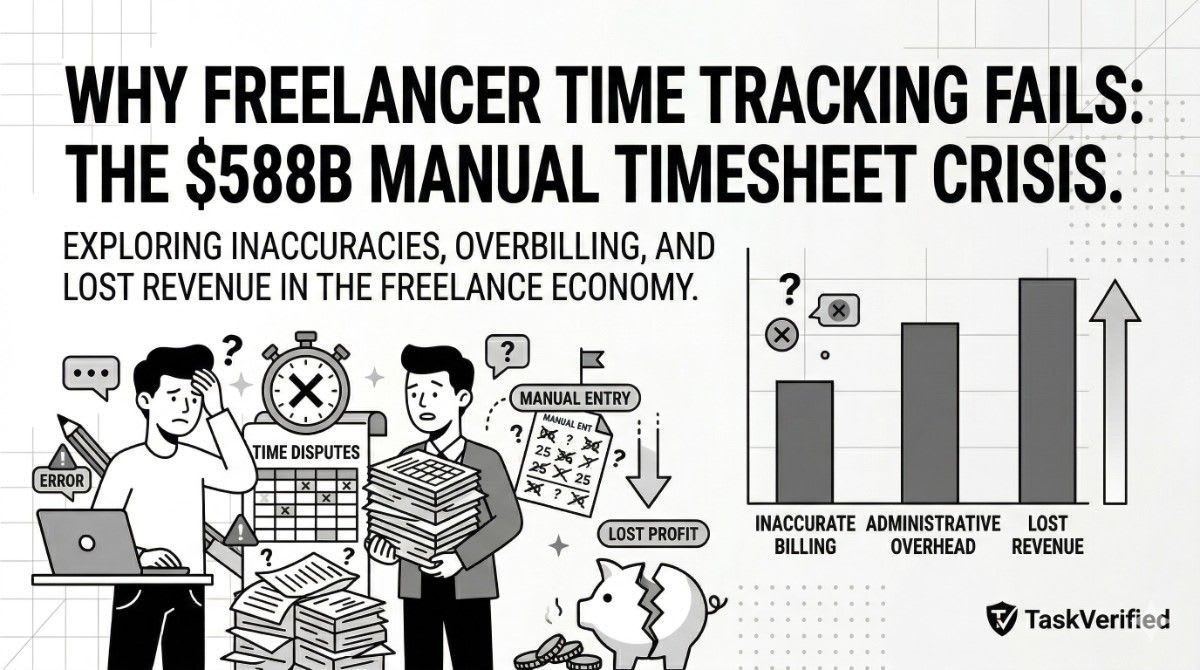
The reliance on manual timesheets is no longer just an administrative headache. It is a systemic financial risk that drains $588 billion from the U.S. economy every single year.
Most legacy time-tracking applications are fundamentally flawed because they focus on presence rather than provenance. This creates a "Black Box" that fractures the entire business lifecycle.
When tracking fails, it triggers a cascade of disputes, reworks, and payment delays. Beyond the balance sheet, the constant friction of "trust-but-verify" increases irritability and damages the mental reliability of high-performing teams.
In this manifesto, we explore the eleven critical failures of modern timekeeping and how they impact: Billing Accuracy • Invoicing Speed • Productivity • Dispute Reduction • Team Health • Long-term Growth
The Financial Reality
Data from FinancesOnline and the Freelancers Union indicates that unrecorded work and time theft cost businesses up to 7% of total payroll. Daily, the U.S. economy loses approximately 50 million productive hours due to unrecorded tasks.
The Budget Hemorrhage (Estimated vs. Max Caps)
The Friction
Manual tracking often lacks a "hard stop," relying on the freelancer's discretion to notice when a budget threshold has been crossed. This creates a "Billable Leak" where projects go 200% over budget simply because the worker "just kept working" through a technical hurdle without authorization. When the invoice arrives, it triggers an immediate financial crisis for the employer and a credibility crisis for the freelancer.
This systemic lack of control forces founders into a perpetual state of "billable anxiety," where every active task feels like a potential liability. Research indicates that 38% to 43% of hourly workers admit to time-theft or unintentional overbilling when tracking is left to manual discretion. Without a technical guardrail, your cash flow is at the mercy of human memory, leading to toxic "write-off" conversations that damage the professional relationship.
The Operational Scenario
A founder sets a 10-hour limit for a landing page. The freelancer hits a technical snag and logs 18 hours before notifying the employer. The extra 8 hours ($600+) create an unauthorized debt that the founder had not budgeted for.
Forensic Core
TaskVerified replaces "honor-system" limits with the Balance Rule. Employers set Max Hour Caps that act as a hard-stop safety gate. If the cap is reached, the timer automatically disables and the employer is instantly notified.
Administrative Ease
This architectural guardrail eliminates "ghost billing" and budget overruns by design. It allows you to manage with zero billable anxiety, knowing that no task can ever exceed its authorized financial envelope without your explicit approval.
The Oversight Blindspot (Real-Time Mirroring)
The Friction
Traditional time-tracking tools operate on a "Post-Hoc" model, where the employer only sees the total duration of work after it has been submitted. This creates an "Oversight Blindspot" where you have no idea if the freelancer is working or if the timer is simply running idle until the end of the week. Without real-time visibility into the *rhythm* of work, you are paying for a total rather than a verified sequence of technical progress.
This lack of visibility is a primary driver of project irritability. When an employer sees a 40-hour bill but the deliverables feel thin, the "Audit Gap" leads to suspicion and micromanagement. Research from the Freelancers Union (2024) indicates that 74% of workers report late payments often caused by these "verification delays." Without real-time mirroring, every billable hour is a "Black Box" that requires a manual forensic audit to justify.
The Operational Scenario
An agency owner sees a 40-hour bill for a task that "felt simple." Without a chronological map of the hours, they cannot verify if the work was one continuous block or a fragmented series of idle-timer blips.
Forensic Core
TaskVerified provides 100% transparency through the Mirroring Linear Timer. This system clones the exact freelancer progress bar onto your dashboard in real-time, showing Approved (Green) and Pending (Blue) segments instantly.
Administrative Ease
This "Mirror-Mode" oversight allows you to see the financial and technical progress as it happens. By visualizing the work as it occurs, you eliminate the need for end-of-week interrogations and audit-anxiety.
The Trust Deficit (Evidence-Enforcement)
The Friction
The core failure of traditional hourly tracking is the absence of objective evidence. In most systems, "1 hour" is just a subjective number on a ledger. This lack of provenance makes billing a matter of faith rather than a matter of fact. When you pay for "time" rather than "verified output," you are incentivizing presence over performance, which eventually leads to a catastrophic decline in the reliability of your team.
This trust deficit is why 59% of freelancers are owed $50,000 or more in late payments. Employers withhold funds because they lack the "Forensic Proof" to approve the invoice with confidence. Forcing freelancers to engage in "activity theatre" for screenshots destroys mental health, yet leaving tracking to unverified manual logs destroys the budget. The only path forward is to bridge this gap with technical evidence.
The Operational Scenario
A developer logs 5 hours for "debugging" but provides no PR links, commit hashes, or Loom recordings. The employer is forced to pay for "presence" without any tangible proof of the technical work achieved during those sessions.
Forensic Core
TaskVerified bridges the gap through Evidence Enforcement. Freelancers are required to attach a link or file proof (GitHub PR, Figma link, or Recording) to every work log, ensuring that all billable time is backed by tangible progress.
Administrative Ease
This creates a Non-Repudiable Settlement Ledger. You no longer "guess" if the work was done: you see the evidence-pack attached directly to the billable minute, allowing for instant, high-confidence approvals.
The Settlement Stagnation (Log Approval Handshake)
The Friction
Traditional invoicing is an "all-or-nothing" game. If an employer finds a single 15-minute discrepancy in a 40-hour weekly report, the entire progress of the project often halts until the dispute is resolved. This fragmentation kills the velocity of your pipeline and creates systemic irritability for both parties. Without a granular review cycle, a minor misunderstanding over a single log can delay a $2,000 monthly payment for days, leaving high-performing talent stressed and unfocused.
This "Dispute Deadlock" is a primary cause of professional churn. When a freelancer is unable to pay rent because of a $50 disagreement, their loyalty to the project evaporates. Research from the Freelancers Union (2024) indicates that 74% of workers report late payments often triggered by these minor "invoicing bottlenecks." Breaking this cycle requires moving from monthly audits to incremental, log-by-log approvals.
The Operational Scenario
An employer discovers one unverified hour in a $2,000 monthly report. The entire payment is "Paused" for 7 days while they argue over $50, leaving the freelancer financially stranded and frustrated.
Forensic Core
We solve the deadlock through the Log Approval Handshake. This real-time review cycle allows you to approve or reject work log-by-log. You can even toggle between blocking (must approve to continue) or continuous flow.
Administrative Ease
By dealing with discrepancies as they happen, the month-end settlement becomes a zero-friction event. You ensure that the freelancer is paid for 100% of the verified work without the entire project grinding to a halt over minor errors.
The Temporal Drift (Linear Fidelity)
The Friction
Most timekeeping tools are simple client-side stopwatches. If a browser tab closes, a battery dies, or an internet connection drops, the active state of the timer is often corrupted or lost. This "Temporal Drift" forces the freelancer to guess their end-times and reconstruct their day from memory—which is 20% inaccurate by default. For the employer, this drift means paying for 20 minutes of "guesstimated" clock-time that never delivered technical value.
This systemic inaccuracy does more than just drain the budget; it poisons the "Digital Integrity" of your workforce. When a developer's laptop crashes, you are suddenly paying for presence rather than provenance as they log a manual hour to compensate for the lost data. This friction increases project irritability as the employer feels overcharged for unrecorded minutes and the freelancer feels stressed by the technical failures of their toolset.
The Operational Scenario
A designer's laptop crashes 45 minutes into a deep-work session. When they reboot, the local timer is at zero. They guess "I worked for an hour," creating a 15-minute fiction on the ledger.
Forensic Core
TaskVerified replaces stopwatches with the Linear Fidelity Protocol. Every billable minute is tied to an immutable, server-synchronized TrustClock that survives crashes, device switches, and session timeouts.
Administrative Ease
This architectural truth gate physically blocks "ghost hours." It provides 100% temporal integrity for both parties, ensuring you only pay for the exact duration of the technical session, not the freelancer's best guess of when their battery died.
The Attention Tax (Graceful Nudges)
The Friction
Humans are fundamentally unsuited for administrative hygiene when engaged in deep, creative work. Forcing a freelancer to "remember" to log their work every hour is a form of cognitive load that destroys focus and reduces the mental reliability of your team. When a worker forgets to submit a log for six hours, they are forced into a "reconstruction panic" at the end of the day, creating a margin for error that ruins the project's forensic audit-readiness.
This "Attention Tax" is a primary cause of professional burnout. High-tier talent will always migrate toward systems that value their creative bandwidth and minimize administrative interference. For the employer, this lack of real-time documentation is why 59% of freelancers face late payments: when the evidence of work is buried in a 50-email chain, the path to approval is clouded.
The Operational Scenario
A writer finishes a 6-hour sprint and realizes they never started the timer. They now have to manually log a 6-hour block with zero evidence-backdating, which the employer immediately flags as suspicious.
Forensic Core
We automate compliance through the Verification Handshake. A global nudge system (Audio + Telegram + PWA) alerts the freelancer every hour, providing a 10-Minute Grace Period to maintain the trust cycle.
Administrative Ease
This system ensures logs are submitted in real-time without interrupting the creative flow. By automating the capture process, we return up to 6 hours per week to your team, allowing them to stay focused on deliverables while the system handles the accountability.
The Rate Paralysis (Adjustment Requests)
The Friction
Projects are dynamic, but manual tracking systems are often static. When a freelancer reaches a budget cap, the work stops. This creates a state of "Rate Paralysis" where the project sits in dead air while the employer manages their inbox. Without a real-time adjustment mechanic, talent feels neglected and unproductive, while the developer is forced to choose between "working for free" or causing a project delay. This lack of architectural flexibility is why 74% of workers report income-stalling disputes.
This systemic stagnation damages the metabolic velocity of your company. When a high-performing individual has to wait 72 hours for a simple "budget bump," their loyalty to the project declines and their focus shifts. For the employer, this friction increases irritability because they are forced to deal with "emergencies" that could have been handled through a structured technical handshake.
The Operational Scenario
A designer realizes the task requires a specialized library that will take 4 more hours. They hit the cap at 5:00 PM on a Friday. The project stalls until Monday because there's no way to request a "Budget Enhancement" instantly.
Forensic Core
We solve the paralysis through Adjustment Requests. Freelancers can request more time, budget enhancements, or even rate increases directly within the task lifecycle, keeping the workflow alive 24/7.
Administrative Ease
Experience a "Request and Approve" workflow that maintains project momentum. You receive a structured request with technical context, allowing you to approve budget pivots in one click without the inbox noise of legacy systems.
The Reconciliation Nightmare (Invoice-Sync)
The Friction
The average freelancer-employer relationship generates dozens of data points across multiple projects. Manually bundling these into a tax-compliant invoice is a primary driver of administrative noise and payment delays. Research indicates that invoice errors cost companies $700 per incident in lost administrative time. When you receive 10 separate invoices for 10 different tasks from the same freelancer, you are essentially paying for their "Accounts Payable" workload as much as their work.
This "Data Fragmentation" destroys the mental reliability of your finance team. When every payment has to be manually cross-referenced against a scattered history of Slack logs and emails, the path to payment moves from Net-15 to Net-30 or worse. This friction creates a "Financial Delta" that obscures your real-time cash flow, making it technically impossible to scale your agency with any degree of forensic precision.
The Operational Scenario
An employer receives five different invoices for five different tasks. They spend their Sunday cross-referencing each one against a manual timer, doubling their "Accounts Payable" workload for a single freelancer.
Forensic Core
TaskVerified ensures that Consolidated Invoicing is the standard. Both the timer and the ledger are aware of the task and the duration, automatically bundling all approved logs into a single connection-level invoice.
Administrative Ease
Experience the "Ghost-Writen" billing cycle. By automating the bundle, you ensure that every invoice is 100% accurate and audit-ready upon arrival, allowing you to settle the debt in seconds rather than hours.
The All-or-Nothing Trap (H:M:S Precision)
The Friction
Reviewing freelance work involves nuance. Sometimes a worker is 90% productive, but those 10 minutes of "administrative drift" or personal calls shouldn't be billed. Most systems force an "Accept or Reject" decision on the entire hour. This "Binary Choice" is why 45% of disputes are caused by quality dissatisfaction. Forcing an all-or-nothing approval leads to "Dispute Friction" and payment delays, as minor discrepancies turn into major financial events.
This binary trap destroys professional relationships. When an employer rejects a legitimate session because of a minor error, it signals to the freelancer that their work is not being authentically valued. The friction of an entire invoice being "held up" by a 15-minute discrepancy triggers irritability and a defensive posture. Scaling a company requires a model where you can "Trim the Fat" precisely without damaging the trust cycle.
The Operational Scenario
A freelancer logs 1 hour, but the employer thinks they worked for only 45 minutes because of a personal call midway. Instead of rejecting the whole hour, they need to adjust the duration precisely.
Forensic Core
TaskVerified provides Granular H:M:S Precision Control. Employers can adjust and approve exact time increments. The rejected portion is magically "refunded" to the budget cap, maintaining absolute financial balance.
Administrative Ease
This non-destructive adjustment process ensures you pay for the exact value delivered. It reflects instantly in the timer clock, invoices, and analytics, allowing for fair-market settlement with zero emotional friction.
The Black Box Paradox (Atomic Clock Sync)
The Friction
Traditional time-tracking is a "Flat Entry." You see a final total of "8 hours" but you have zero visibility into the rhythm of the session. How many times did the worker pause? Was that 8-hour block one continuous session or a disjointed series of 15-minute bursts? Without an atomic event log, "1 hour" is a black box that hides the *context* of the labor. Market data reveals that 43% of workers admit to overstating their time because these flat entries are so easy to manipulate.
This lack of technical visibility is a primary driver of organizational irritation. When an employer sees 8 hours for a task that usually takes 2, but has no technical map to audit, the "Trust Gap" becomes a "Financial Sinkhole." Scaling a company requires moving from "Totalized Minutes" to "Atomic Sessions," ensuring that every billable event is indexed against its own lifecycle of starts, pauses, and resumes.
The Operational Scenario
A freelancer logs 8 hours on a Sunday but refuses to explain why it took 8 hours for a task that "felt simple." Without a granular event log (Start/Pause/Resume), the employer has zero objective visibility into the session's technical friction.
Forensic Core
TaskVerified replaces flat entries with Atomic Action Logging. Every interaction with the timer (Start, Pause, Resume, Stop) is logged as an immutable, server-side event, providing a high-resolution map of the session.
Administrative Ease
You move from "Guessing" to "Knowing." By visualizing the atomic history of the billable session, you identify technical bottlenecks and productivity trends with 100% audit-readiness in seconds.
The Operational Lag (Log Frequency Control)
The Friction
The first 48 hours of a new hire are a high-risk zone for project alignment. Allowing a transition-period worker to log 8 hours without a verification check-in is a "Liability Gamble" that often ends in wasted capital and three days of reworks. Research shows that early project friction accounts for 74% of dispute-related churn. Without a way to enforce technical check-ins, the "Sunk-Cost" of bad onboarding becomes a systemic risk to your company's scalability.
This "Onboarding Blindspot" destroys the mental reliability of your management team. When a manager has to wait until Friday to see if the new talent is "on track," the project velocity stalls. Moving from trust-based onboarding to verification-based onboarding requires the ability to adjust the "Accountability Frequency" based on the worker's proven track record.
The Operational Scenario
A new hire works for 8 hours on the "wrong branch" because they weren't nudged to sync their work until the end of the day. The employer loses $400 and a full day of development progress.
Forensic Core
TaskVerified enables Frequency-Controlled Handshaking. Employers can enforce "Every Hour" logs for new hires, forcing a verification sync that ensures alignment before the budget is burned.
Administrative Ease
Experience risk-mitigation by design. By enforcing high-frequency syncs during the onboarding phase, you ensure that every hire aligns with your technical standards in real-time, reducing the "Sunk-Cost" of reworks by 90%.
TLDR: The Forensic Shift
The Manual Crisis
Traditional tracking is a "Black Box" of 20% inaccuracy, unauthorized overbilling, and invasive surveillance. It incentivizes "Activity Theatre" while destroying project velocity and team trust.
The TaskVerified Cure
We replace guessing with Forensic Evidence. Max Hour Caps, Real-Time Mirroring, and Evidence-Linked Logs provide 100% financial and technical integrity without surveillance.
The Forensic FAQ
How does a "Max Cap" differ from a "Reminder"?
Reminders require human intervention to work. TaskVerified's Max Hour Caps act as a technical hard-stop: the second the limit is reached, the timer disables and the ledger locks. No unauthorized debt, no "oops" hours.
Wait, no screenshots? How do I trust the work?
Screenshots are invasive and easy to fake. We use Evidence Enforcement + Real-Time Mirroring. You see the progress bar move in real-time, and every billable log must be backed by a GitHub PR, Figma link, or File proof. Proof of Work, not "Proof of Presence."
What if I only want to approve part of an hour?
Our H:M:S Precision Control allows you to adjust and approve any increment. If a freelancer logs 60 minutes but took a 15-minute call, you approve 45. The remaining 15 minutes are automatically "refunded" to your task budget cap.
How do you handle device failures or crashes?
Everything is backed by Linear Fidelity (Server-Side Sync). Our timer state isn't stored in a browser tab—it's mirrored on our servers. If the freelancer's laptop explodes, the timer data remains sub-second accurate and waiting for them on any other device.
The Future is Forensic
Eliminating the time-tracking black box is the first step toward a high-fidelity workspace. By moving project financials from "Subjective Fiction" to a "Verified Ledger," TaskVerified allows you to scale your agency with absolute administrative peace. Truth is not a matter of perspective when the data is immutable.

